
October 31, 2026
What Could Tokenization Mean for Curaçao?
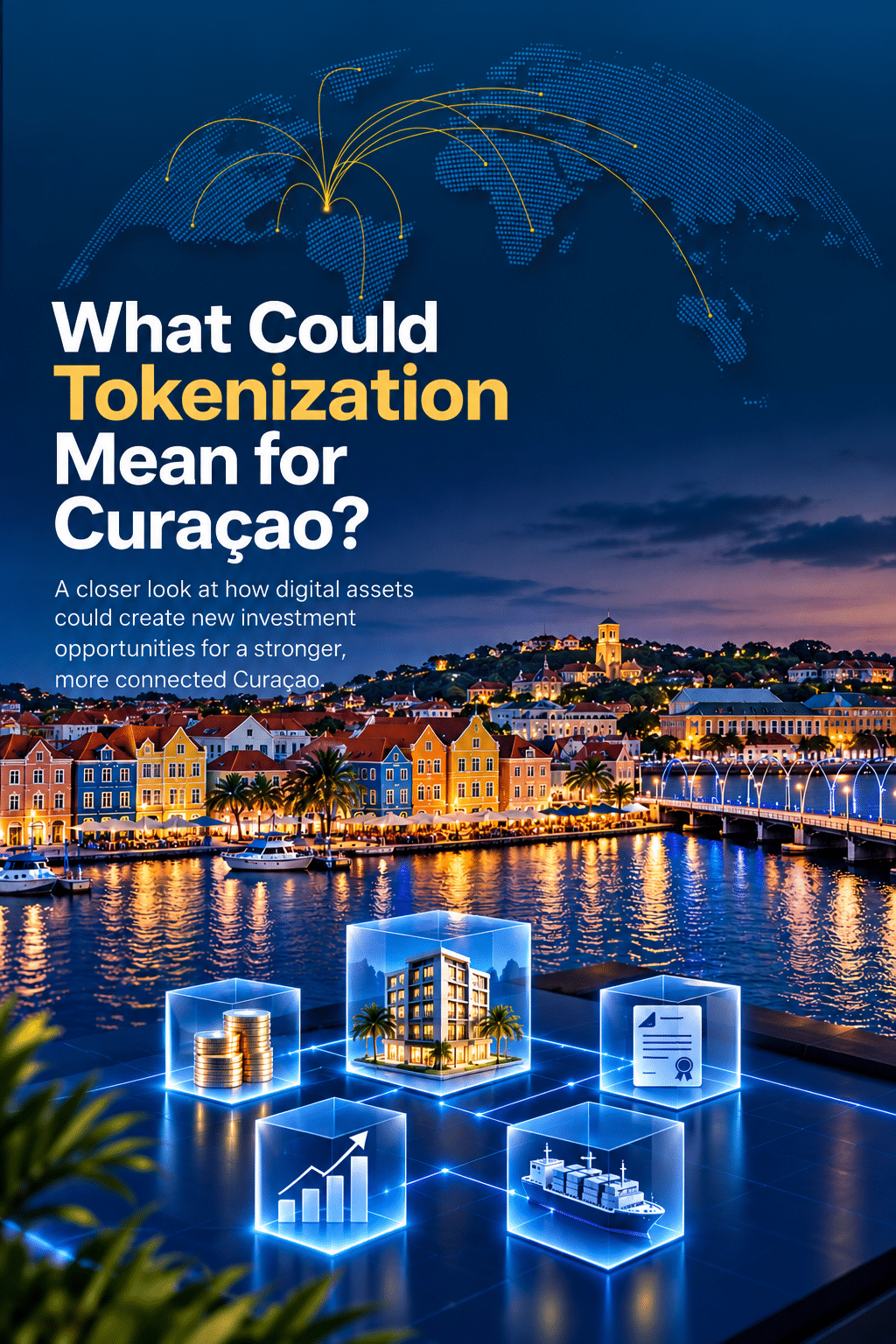
In our previous publication, we explored tokenization: the use of blockchain or distributed-ledger technology to digitally represent traditional financial and real-world assets. We saw that shares, bonds, investment funds, and even interests in real estate can potentially be represented digitally. But this raises another, perhaps more interesting, question: What could tokenization mean for Curaçao? For a relatively small island, this is not necessarily a small question.
Curaçao already has a financial foundation
Curaçao has a long history as an international financial center. It has experience with securities, investment funds, trusts, corporate structures and cross-border financial services. This existing financial knowledge could provide a foundation for new forms of digital finance.
The Centrale Bank van Curaçao en Sint Maarten (CBCS) has identified tokenization as an area of FinTech activity with potential relevance to Curaçao. CBCS research has noted possible benefits including greater accessibility, increased liquidity for traditionally illiquid assets, transparency of ownership and lower administrative costs.
Making local assets more accessible
Consider real estate. Investing directly in a commercial property, hotel or development project normally requires substantial capital. Tokenization could potentially allow an economic interest in such an asset to be divided into smaller digital units. Instead of one investor providing a very large amount, a structure could potentially allow a larger number of eligible investors to participate with smaller amounts.
The same concept could potentially be applied to businesses, investment funds, bonds or infrastructure projects. This is sometimes described as the democratization of investing: using technology to lower some of the practical barriers that have traditionally made certain investments difficult to access.
Connecting Curaçao with investors beyond the island
Tokenization could also have a cross-border dimension. Curaçao’s domestic market is relatively small. Technology, however, is not restricted by physical borders in the same way traditional financial infrastructure can be. Digital financial infrastructure could therefore make it technically easier to connect Curaçao-based businesses and investment opportunities with a broader pool of investors.
Earlier this year, we discussed how a well-functioning stock exchange can connect businesses that need capital with investors looking for opportunities. Tokenization does not change that basic economic function. Instead, it could provide another technological way of facilitating it.
Could Curaçao become a regional hub?
There is another possibility. Rather than looking only at tokenizing Curaçaoan assets, Curaçao could potentially provide financial services and infrastructure supporting tokenized investments elsewhere in the Caribbean and Latin America. Its geographic position, international orientation, and existing financial-services sector could provide a basis from which new services develop.
These might eventually involve areas such as issuance, administration, trading infrastructure, custody and other professional services surrounding digital securities. But technology alone will not create a financial center.
Innovation still needs trust
Tokenization can change the technology used to record and transfer an investment. It does not make the fundamental questions surrounding an investment disappear. Investors still need to know who issued the investment, what exactly they own, what rights they have, where the underlying asset is held, who safeguards it, what happens if something goes wrong, and which laws and regulations apply.
Those questions become especially important when investors, issuers, technology providers and assets may all be located in different countries. For this reason, tokenization is not simply a technology question. It is also a question of trust, regulation, market infrastructure and investor protection.
This is particularly timely. The CBCS’s October 2026 FinTech Conference focuses on ‘Stablecoins, Tokenization, and the Future of Trust’, including how tokenization could develop into regulated market practice.
An opportunity worth exploring
Tokenization is still developing, and it would be premature to assume exactly how large its role will become in Curaçao. But the underlying opportunity deserves attention.
Curaçao already has financial expertise. It has a regulated securities exchange. It has an internationally oriented economy. And it operates in a region where businesses continue to need better access to capital.
The question may therefore not simply be whether tokenization is coming. A more useful question is: How can Curaçao use this technology responsibly to create new investment and financing opportunities while maintaining the trust on which financial markets depend? That is a conversation worth having.